Tales from a Wayside Station


SONEGAON, KANHAN, KHAPRI, Dongargaon, Kamptee... ask any old timer and he will tell you that these were once tiny settlements dotting the city of Nagpur, small villages where lived humble village folk who lived unpretentious lives and earned their bread by the sweat of their brow.

    These were simple folk who pursued simple village trades. Thus there was the village barber and the blacksmith; there was the carpenter and the electrician, the plumber and the local school master. There was the village tailor busy on his treadle machine making garments for children and grown-ups alike. And needless to say, you had the odd grocer with his tiny shop who stocked up provisions and daily essentials needed by all and sundry who lived in the village.

    There were others who tilled their land under the sun, who were sons of the soil. These men and their wives tended to their fields and grew their vegetables, their corn and their wheat and their fruit. Their produce was sold in colorful weekly village bazars welcomed by one and all. 

    A few of these men were more adventuresome, they would travel all the way to the city to sell their produce: their freshly picked brinjals and tomatoes, capsicums and cucumbers, onions and coriander. A trip to the city was a welcome change for the villageman: it afforded him relief from the monotony of village life, and besides he knew his produce could fetch a higher price in the city.

    Amongst this varied crowd that you saw in the village, a few like old Mr Kale who lived in Khapri, were lucky enough to find work in government offices and business establishments in the city. Some even found work in cloth mills and industrial units such as the once famous Empress Mills of Nagpur. These men were looked up with awe and respect; they apparently seemed to possess a certain dignity that others were seen to be lacking in. They came to be considered as the elite of the village. 

    The elite folks then had to shuttle each day between home and place of work. If the village was close enough to the city, the men used bicycles for transport. It was both cheap and convenient. This was precisely what Mr Kale did who worked all his life as a sorter in a post office in the city of Nagpur. Old Mr Kale rode on his bicycle each day to town to attend to his job at the post office. There was a train that would bring him to the city in the mornings, but Mr Kale would have nothing to do with it, he would rather prefer his crumbling old bike. He was a calm sort of man given to a good deal of contemplation, and in his wisdom he knew his bike could be trusted to get him to office on time; the train from Bhusaval could not, for it was often late by several hours.

    What kind of a train was it that Kale and others like him sought to avoid at all costs? It could not have been an express, for no express would care to halt at a small village halt. It was a legendary train in many respects, legendary not on account of its speed or timeliness, but by virtue of its spanning two cities nearly four hundred kilometers apart --  the longest run a Passenger train had ever been called upon to perform. It also owed its fame to yet another facet of its operation, which was the choice of locomotive that was assigned to it: old timers recall with great nostalgia the Bhusaval Passenger steaming out of Nagpur under charge of a bullet nose steam loco, the most attractive locomotive that ran on the metals of those days.

    It is as well to remember that there were in actual fact two passenger trains originating from Nagpur, both bound southwards on the broad gauge line back in the seventies. There was the Bhusaval Passenger we have just seen, run by the Central Railway. The other was the Kazipet Passenger. One started in the morning, the other in the evening; both followed the same route till they reached Sewagram. Now discontinued from service, these were long distance passenger trains, both safe and inexpensive, but were often subject to long delays at roadside stations along the way. Barring this disadvantage, they were fine trains with plenty of accommodation. If you were in the mood for a train ride, nothing could be better than to pack up a lunch case and buy a ticket for a station nearby, preparing yourself to make the return trip by bus. 

    One of the last trains in the Nagpur area to be powered by steam, the Bhusaval Passenger was often late both in arrival as well as departure. This fine train was a pleasure to ride, it handled points and turnouts with incredible smoothness and ease; there was never a sense of haste as it traversed the landscape; and it courteously called on each wayside station as it merrily chugged along. It was truly a vintage train; a rail enthusiast's delight. 

    Leaving Nagpur behind, the very first stop was at Ajni, where there was a large wagon interchange point, then on to Khapri, where an LPG gas bottling plant had come up, and where Kale had his home in the rural setting of the village. Beyond Khapri, the line would lead on to Dongargaon, barely six kilometers away, another rural station serving a village. But the station in Dongargaon was strangely named Gumgaon. What might be the reason for this discrepancy in nomenclature, I cannot say, but here stood the little station with a tiled gabled roof amidst a desolate low level platform. Gumgaon was the archetypal village station: it was prettiness personified.

    Khapri was no less picturesque. It too had an eye catching liitle station. It had a lovely pitched roof with tiles, and was elegant in style. It was simple and functional in architecture. 

    Then came along the twenty first century bringing with it burgeoning trade and commerce, a mass application of the computer to nearly every sphere of life, an increase in living standards, ever increasing educational opportunities, and vastly increased travel. The old stations in Khapri and Gumgaon could not keep pace with these new innovations. A Metro had meanwhile come up in Nagpur, the line going all the way upto Khapri. The old station here was then pulled down, new platforms built, and the yard remodelled to accommodate extra goods lines originating from the newly set up Container Corporation nearby. 

    Khapri is no longer the quiet little hamlet it once was, but is a growing township, the home to corporate giants like Infosys, the Container Corporation, Amazon, and the All India Institute of Medical Sciences. In nearby areas such as Gumgaon and Jamtha, we see similar developments in the form of engineering and nursing colleges, open air family restaurants with spacious lawns, and a world class sports stadium built by the Vidarbha Cricket Association.

    One of my bitter regrets in life centers around the railway in Khapri. This pretty little station disappeared from view ere I could ever train a camera on it. That it would be razed to the ground without a thought for its heritage value, I had never once imagined. I had been presumtuous, thinking Khapri would live on forever, little realising that the arrival of the Container Corporation next door signalled the end of the old order and the beginning of a new one.

    But all was not lost. Seeing that Khapri had passed into history, I set my sights on the next station a few miles down the line, making the happy discovery that the station there still stood as it must have done a century ago. Gumgaon station still remains, getting on in years, like a cask of old wine that gets better the older it gets. Its tiled roof has been replaced with tin, but it is still pleasing to look at. One of the last remnants of the steam age on this line, there's no saying when this too might be demolished, for a modern Station Master's office built of concrete and buzzing with computers and telephones is already in operation a few meters away. The old station's days are clearly numbered.


    Like Khapri, Gumgaon station hardly sees any passengers, for road transport has been developed to the point where it is both fast and efficient. You step into the station and find not a soul in sight, the platform solitary and deserted as far as the eye can see. The MEMU bound for Wardha calls here in the morning, the occasional passenger climbs aboard, and in a matter of seconds, the train honks and begins to move out. Thereafter for the remainder of the day, the station stands in solitude and silence.

    How long will the old station of Gumgaon stand only time can tell. The Station Master's office which once resounded to the sound of bells on the train instrument, is now bare, and is used by trackmen dressed in orange shirts to rest awhile when they get a respite from their arduous duties out under the blazing sun. At the entrance is a heap of scrap metal, old rails and pieces of equipment now obsolete. The ticket booking window still remains, the wooden gate leading to the platform still swings open as it did in the days of old.

    I found rusty old iron benches along the rail platform of Gumgaon. Then there are, at intervals, small canopies with pretty red concrete benches under their shade where travellers could rest awhile. It looks so pathetic, such a sad irony : these colorful platform canopies... all to what purpose? There's hardly ever a passenger in sight at the station, not even for the MEMU. And yet the rustic seats remain, as though in anticipation for a tired traveller to come along and take his seat.

    I seated myself on a bench in the warmth of the winter sun and proceeded to unpack my lunch box. Express trains rumbled by at full speed, screaming as they passed, drivers holding out fluttering green flags as they rushed by in haste. When the train had passed and the din had died, it was all quiet again. I could hear only the chirp of the birds, or the quiet tinkling of a bell showing a cow was grazing nearby beyond the hedge. 
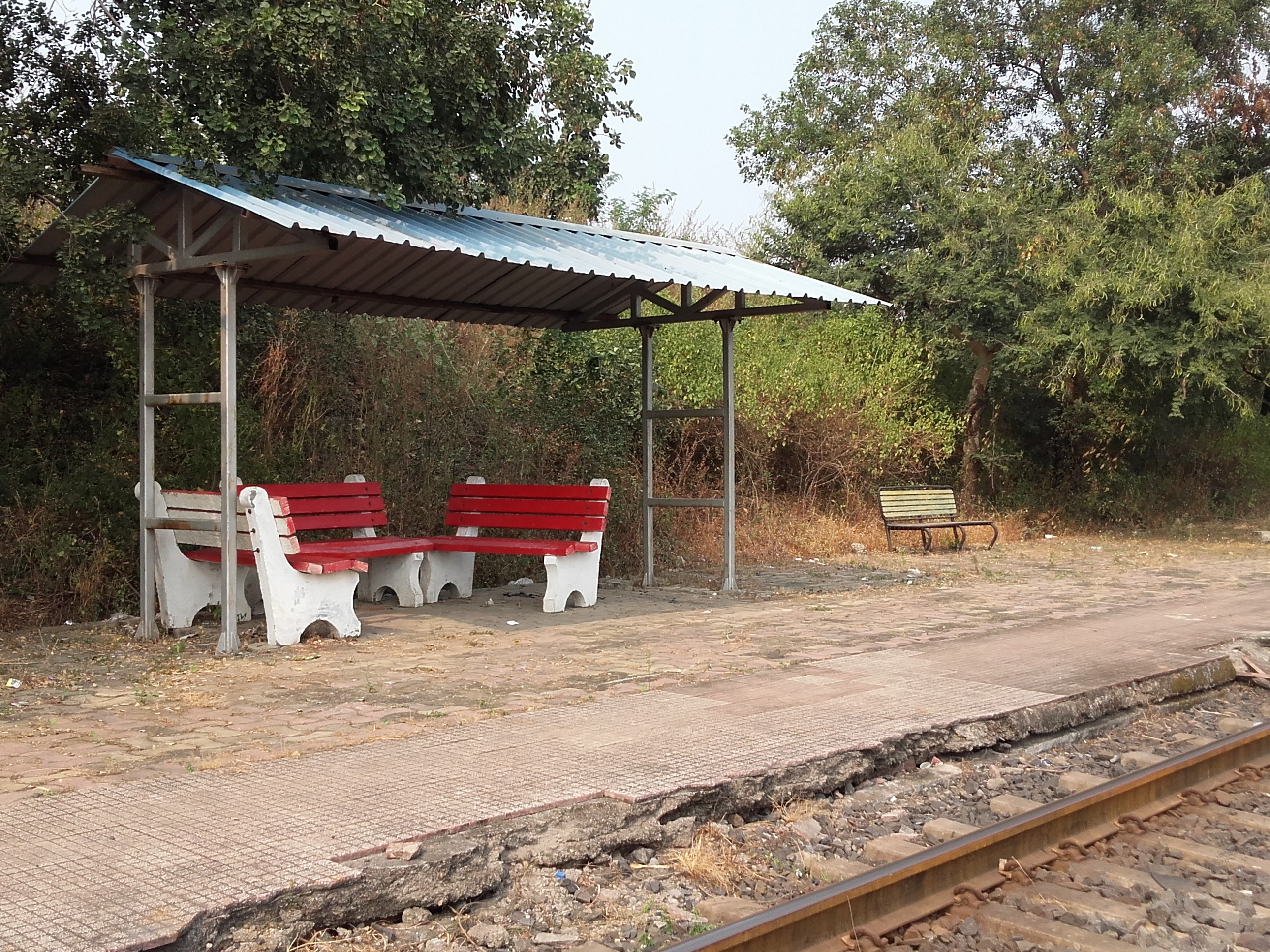

    Gumgaon station puts me in the mood for philosophical contemplation. These metals here have served their purpose here for over a century, the station name board stands in the far distance unyielding, in fading colors against the pale blue sky. But what is this I hear -- did I hear someone strike two beats on the station gong? Who knows, someone did really strike the gong, and I must investigate. I rose, had a sip of water from my bottle, and strolled up to where the old station stood. To my great astonishment, the station is all abuzz with life, the Station Master and his men busy at work. The equipment in the office itself is minimal, I notice: a control telephone, double line block instruments, various train record registers, hand lamps, flags, a supply of kerosene, and other railway bric-a-brac. 

    Walking over to the waiting hall, I find a small group of rural folk standing in queue at the ticket window leisurely buying their tickets. Clunk-thud goes the ticket machine, as the booking clerk stamps his tickets, then the usual jangle of coins. The village folk slowly make their way to the platform where they assemble in groups, waiting for the morning train bound for Bhusaval. This train will take them on to Butibori, to Tuljapur or maybe Borkheri, to distant Sewagram and even beyond. It is late, I am told, but these people will wait on for their appointment with their beloved train. The semaphore pointing downward tells me that it is due.

    A long scream of an air horn followed by the rattle of carriages aroused me from my blissful reverie. I glanced around and found no one was in sight; the platform was bare and solitary. I rose from my bench and slowly made my way to the old station. It was locked, the booking window thickly covered with dust, the passenger waiting hall showing no signs of use. The station gong still hung in place. No one had struck it for years.

    I stood for a while contemplating. Set amidst trees and overgrown shrubs, this station would last for an eternity if no one touched it. It would last an eternity in solitude and deep silence, whispering tales from its distant past.

....................

Ravindra Bhalerao

The Invincible Railway Traffic Official


Between the Lines: A Railman's Journey, by Annavarapu Ramarao; Notion Press, 2022; pages 540, Rs 575.

..................................


THERE WAS BUT A NARROW strip of roadway that led out eastward from the town of Kamptee leading on to the small village of Kanhan that lay beyond the river. The roadway, which was never too busy a hundred years ago, passed through the cantonment of Kamptee, running beside the railway line to Bilaspur, before passing over the mighty bridge that spanned the river Kanhan. This road bridge, running alongside a parallel rail bridge and built of several sandstone arches still stands, although now lying forlorn and abandoned on account of its advancing age. Its decorative iron railings are still in place, carrying underneath its sweeping arches the quiet waters of the meandering Kanhan.

     On this bridge could be seen many years ago a simple young lad, about ten years of age, satchel in hand, trudging back home on weekends with his siblings and friends after attending the Hindi primary school in the nearby town of Kamptee. The walk along the solitary roadway was a leisurely exercise and always great fun; the boys laughed, treating themselves to tidbits. A little way down the line they halted, and hurled stones at fruit trees, picking up guavas that dropped to the ground. 

     The young lad whose fortunes seem to us worthy to record here belonged in fact to a family of railwaymen. His father served as Station Master of Kanhan Junction, a station on the Bengal Nagpur Railway; and what is even more remarkable, his grandfather too had served on the railway at one time in the distant past.

     And so the boy with the satchel walked on under the sun, his gaze darting hither and thither, thinking of his games and laughing with friends, lost in a world of his own. Who would have ever imagined in his wildest dreams that the lad, frolicking with his friends on his way home would go on to hold the office of Chief Operating Superintendent on the railways one day!


     The book under consideration here is an autobiographical account of an Indian Railway Traffic Service Officer, beginning with young Ramarao's boyhood days spent in railway quarters in Kanhan in the late nineteen thirties and early nineteen forties. Within its pages is woven a narrative that sets forth events of the author's days beginning with home life, education, and his selection for railway service, and going on to describe in considerable detail his subsequent career as a senior Officer of the Indian Railway Traffic Service. 

     Growing up in railway quarters in Kanhan in the forties, Shri Ramarao tells us that railway families in small towns often reared cows for milk, and he fondly remembers the time when he and his brothers played with toy trains the boys had made themselves using matchboxes and torch batteries. His tryst with the primary school in Kamptee soon over, the lad was sent to Nagpur, a bare twenty kilometers away, to attend high school, to be followed by college education. There were trials and privations to be endured along the way, but with understanding and supportive parents the boy emerged victorious in a few years time, armed with a master's degree in Chemistry. 

     The young man now stood at the crossroads of life. His very first assignment would take him to Jabalpur where he found work as a college lecturer in Chemistry. Fortune favours the brave and the ambitious it is said, and young Ramarao possessed both these attributes in no small measure. The turning point in his career would come when he appeared for the Central Services examination in 1956. The outcome of this bold move was far from certain. If he succeeded, it would propel the young man on towards a bright and promising career. Would he succeed in clearing the much dreaded UPSC examination?

     Annavarapu Ramarao did perform well, both in the written test as well as the interview that followed. A year later there came a letter through the post. It was an appointment order asking him to report to the Eastern Railway headquarters in Calcutta. Ramarao had been appointed to the Superior Revenue Establishment of the Traffic (Transportation) and Commercial Establishments of the Indian Railways, the forerunner of the Indian Railway Traffic Service, and to begin with, would serve as a probationary officer on the establishment.

     Much like a train that begins to pick up speed soon after it has cleared the yard, the book really begins to take off from here. We now begin to see how a trainee officer in the railways learned his trade from scratch. Other than familiarising himself with the General Rules, the new entrant had to learn basic train operations from goods clerks, station masters, yard masters, guards and others. Trainees were made to work as goods train guards, even travelling on locomotives of coal pilots that shuttled between the yard and the several collieries situated in the coal belt of eastern India. They were required to keep meticulous notes of the yards and signal cabins they visited, their progress being carefully monitored by senior officials assigned with the task of supervision.    

     The author's first posting was as Assistant Commercial Superintendent holding charge over Howrah station and Parcel sheds. It was an imposing responsibility and one of the first things he would discover on his arrival here was that there was a great deal he had yet to learn. And yet, learn he must, if he would succeed. He ploughed on steadily, growing in stature whilst at the same time establishing a reputation for himself as a sincere and honest official. In the meantime, he would also go on to make new friends, get to know trade union leaders, and familiarise himself with the system as a whole.

     As the reader can well imagine, the scope of activities at Howrah station was tremendous, and the organisation itself, a vast one. Reading this account one can almost sense the frenzied rush on Howrah station, the ceaseless flurry of activity at the goods sheds, and the surging, restless crowds that characterised the working of this busy terminal on Eastern Railway.

     The early chapters of the book are going to find great favour with steam locomotive enthusiasts, for Shri Ramarao's assignments would lead him to spend a great many years in the coal belt of eastern India. 

     His first job here would take him to Asansol on the post of Divisional Operating Superintendent (Goods). Here in the very heart of the coal mining industry, we are told that as many as two thousand wagons loaded with coal would originate each day. There were over 300 sidings on the division serving mostly underground mines. Empty wagons drawn out from major yards in the division would make their way to these sidings each day, hauled by steam locomotives. The coal pilots, as they were known, were loaded with coal at the sidings and would return to the yard for onward despatch of coal. As may be expected, the air was thick with coal dust, and although electrification was in progress, steam locomotives were still very much in operation.

     Following a serious train collision at Dumraon station in the early sixties, safety had become a matter of paramount importance. We may savor the pleasure of accompanying Shri Ramarao as he travelled on motor trolleys carrying out station inspections wirhin his jurisdiction to assess if station staff were conversant with safety procedures and rules. He would also go on to inspect yards and sidings, looking for possible causes leading to shunting accidents. 

     Asansol West Yard in particular was the site of frequent derailments and would afford the young railwayman his first opportunity to put his investigative skills to use. He turned his attention to study the problem closely and soon made the discovery that the prime cause for these mishaps occurring on the 'king point' of the yard lay in the poor visibility of the summit of the hump from the yard cabin that mechanically operated the points. It had been a recurrent problem for years. Shri Ramarao had the system altered by having locally operated points installed close enough to the offending point, thereby eradicating the trouble altogether. 

     As a traffic officer Shri Ramarao would show himself to be a great innovator, his analytical mind teeming with new and unconventional ideas. He possessed the uncanny knack of devising ingenious solutions to problems which often presented themselves as insurmountable barriers in the area of railway operation in those times.

     He recollects his days when posted as Divisional Operating Superintendent of Eastern Railway, Howrah, when an opportunity presented itself where he tried out a new innovation he had devised to speed up the clearance of parcels on the station. Being the busiest terminal on Eastern Railway, Howrah had to deal with a large number of trains each day. Unloading parcel vans and handling deliveries was proving to be an ordeal, with the whole process taking place amidst the mayhem resulting from passengers having to pick their way through heaps of packets strewn all around the platform. Given these conditions, dealing with parcel vans was necessarily a time consuming affair resulting in considerable detention to trains arriving at the station. This in turn often led to perishable products like fish and vegetables going bad, besides causing detention at signals to incoming trains for want of platform space.

     It must be understood that this was a perennial trouble at Howrah station in those days, and operating officials were in despair, there being no clear way out of the trouble in sight. But this time Shri Ramarao held charge, and he was not one to easily accept defeat. In consultation with his colleagues, he instructed the Chief Yard Master of the coaching yard to shunt out each arriving passenger train within minutes of its arrival without touching the parcel vans, uncouple the train in the yard, and hustle away parcel vans to the parcel shed platform where goods could be handled without hindrance of any kind. 

     The method was first applied to the Doon Express and later extended to other trains. It was an unconventional procedure by all accounts, but proved to be a great success winning the appreciation of Railway Board officials besides freeing the main platforms of Howrah of the persistent problems of congestion and filth.

     There were numerous other instances, no less demanding, where Shri Ramarao would be called upon to bring his superior abilities and judgment to bear upon situations of a serious nature which had baffled rail transport officials all along and which apparently didn't admit of a solution.

     The book dwells at great length on the subject of Mughalsarai, home to India's famed marshalling yard, and we may take a fascinating tour of the yard and study its evolution and working.

     Towards the 1960s new kind of goods wagons, called BOX wagons had begun to make an appearance on the railways. These were fitted with four-wheeled bogies and modern coupling arrangements designed to withstand larger stresses. The new centre buffer couplers (CBC), as they were known, were a great improvement on the screw couplings found on older four wheeled wagons, but with this advantage came the drawback of having two different kinds of wagons to deal with in the goods yard. Steel devices, known as transition couplers were designed for joining wagons fitted with CBCs to screw coupling wagons.

     Wagons fitted with CBCs proliferated in the 1970s, with the  introduction of covered eight-wheelers (BCX) and covered four-wheelers (CRT), and their incompatibility with screw coupling stock led to serious congestion in railway marshalling yards across the country. Transition Couplers were in short supply because they were prone to theft.

     Shri Ramarao, posted at the time in Mughalsarai as Joint Director, Rail Movement could see the source of the trouble and put forward the idea of collecting CBC wagons on a separate line in the sorting yard, and thereafter re-sorting them into groups according to destination, but his proposals were turned down by Eastern Railway officers.

     Shri Ramarao had also identified another pressing issue, namely, a huge wastage of both time and engine power resulting from changing electric and diesel locomotive of all trains at Mughalsarai, this being an interchange point between Eastern and Northern Railways. His attempts to convince higher officials to change the system was treated with indifference. The intrinsic value of his ideas could only be gauged by a man of the genius of the legendary M S Gujral, who was then posted as Director General (Transportation) in the Railway Board. Taking the cue from Shri Ramarao, Gujral introduced two path breaking innovations, namely, the running of CBC fitted covered wagons in full train loads named Jumbo rakes, and secondly, the abolition of locomotive changes to some trains at Mughalsarai. These innovations became the starting point for Gujral to extend these ideas on an all India basis when he took over as Chairman of the Railway Board a couple of years later.

     The new system, when put into practice, led to a phenomenal improvement in the performance of goods yards at a time when Indian Railways had sunk to an abysmally low level of performance, and forms in large part the basis of goods train operation to be found on the railways today. 


Annavarapu Ramarao as Divisional
Railway Manager of Lucknow Division
of North Eastern Railway in 1982


     As a railway traffic official Shri Ramarao was unexcelled in performance. He possessed a profound understanding of the railway yards under his charge, and when faced with challenging situations he was ever prepared to abandon coventional wisdom and adopt new contrivances if they offered the promise of better returns.

     But other than delighting us with tales of his exploits in the field, Shri Ramarao also gives the reader enough historical context to give him the feel of the times, thus conveying a vivid portrayal of the work culture and social milieu to be found on the railways of the time with particular reference to the eastern zone. 

     Relations between senior railway managers and subordinates were often characterised by an overbearing 'rule of the master' attitude in the early days, a legacy undoubtedly inherited from colonial times. The author having had a first hand experience in this regard while serving as a probationary officer himself, vowed never to achieve subordination amongst his juniors employing such demeaning conduct when the occasion arose.

     The reader will come upon a delightful account here describing how different cadres in the railway organisation arose : the traffic and transportation department, the engineering wing, the Special Class Railway Apprentice 'Gymmy boys' of Jamalpur, as well as other services. Feelings of superiority amongst staff were bound to arise, as they do in any organisation, leading to barriers that impeded the growth of healthy interpersonal relationships between staff belonging to different cadres of the railways. 

     We also have a picture here of civil disturbances, industrial unrest, gheraos of railway officials, workers grievances and trade unions in the railways. The protests periodically launched by workers unions could seriously disrupt rail services leading to significant repercussions elsewhere. 

     We read of a time when a flash strike was launched by railway staff in Dhanbad in the sixties bringing train operations to a dead standstill. Taking along a few trusted Traffic Inspectors with him, Shri Ramarao rushed to Kusunda where the men took over the despatch of coal trains, coupling wagons and setting points and signals all by themselves. Being a successful traffic officer on Eastern Railway clearly called for both presence of mind and a wide range of skills. 

     During the span of his career, the author had twice been on deputation to the Fertilizer Corporation of India to serve as a Traffic Manager. In his later days he would be called upon to visit Ghana as a member of a RITES team sent to infuse new life into an inefficient and shabbily run railway system. Its economy in a shambles, Ghana was served by a narrow gauge railway that seemed to be on the brink of collapse with poorly maintained engines and rolling stock, unremunerative operating practices and the absence of telephonic links. The team got to grips with the battered railway and improvements soon began to follow. A major concern was the consistent derailing of trains, and on close examination this was traced to improper choice of gauge of locomotive wheels during manufacture. Henschel of Germany, who had manufactured these locos, were called in and following negotiations, agreed to replace the wheel tyres free of cost.

     Shri Annavarapu Ramarao had a chequered career, serving four terms as Divisional Railway Manager in the Eastern and North Eastern Railway zones, besides holding top ranking operating positions all throughout his career. 

     His final assignment was as Chief Operating Superintendent of Eastern Railway, Kolkata, an office that was shortly afterwards renamed as Chief Operations Manager. He had begun his career with Eastern Railway, and it was fitting that he should end his career at the place where he had begun. He cast his gaze over the station he had known for so long. It had been through a major refurbishment under Shri Ramarao's own direction some years ago during his tenure as Divisional Railway Manager here. The facelift given to Howrah station had included both cosmetic changes as well as vastly improved passenger amenities, resulting in a monumental transformation that had drawn effusive words of praise from all quarters. Now with only a few more years to go, Shri Ramarao could look upon the edifice of the station with a sense of pride and satisfaction. This would be his last significant contribution towards the functioning and betterment of this great railway he had devoted his life to. 

     Between the Lines makes for intensely absorbing reading, holding a rich historical record within its pages. It lifts the veil giving a rare glimpse into the inside working of the operating and other related departments of the Indian Railways in the latter half of the twentieth century: that fascinating human machinery which planned out railway movements and worked out strategies, all with the single objective of bringing about expeditious, safe and economical transportation of men and materials on rails. 

     Unquestionably a work of great educational value, Shri Ramarao's narrative is also an action packed drama with exciting events unfolding before the reader's eye as he goes along. The student of railway history would do well to devote himself to a thoughtful study of this masterly work that issues from the desk of one who has been an ardent and highly skilled practitioner of the art of railway traffic management.

.......................


Shri Annavarapu Ramarao (b. 1933) retired from the Indian Railway Traffic Service in 1991 as Chief Operating Superintendent of Eastern Railway, Kolkata. Other books on railway themes authored by him include Line Clear to India, Trailing Window: A Journey into Rail History, Nemesis: A Tale of the Emergency, and The Tiger of Bhanwar Nalla and Other Stories. Now settled in Bangalore, where he and his wife live with his younger son and family, Shri Ramarao spends most of his leisure in reading, writing, and watching cricket on television.

......................


Ravindra Bhalerao

The Narrow Gauge Rail Museum of Nagpur

 FOR MANY PEOPLE Motibagh is synonymous with the former South Eastern Railway's establishment here in Nagpur. Coming down from Kadbi Square you couldn't help being so much a part of the railway and its doings : there was the South Eastern Railway Health Centre, the Railway Institute, the workshop and the diesel loco sheds, the railway quarters and the stadium. Motibagh is set in railwayland ; it lies at the junction of a network of criss-crossing rail tracks some laid above the others, and not far from the ever present D-cabin that lies on the main line to Bilaspur and easily seen from the roadway. It can all be seen from the road itself -- even the steam loco shed of the South Eastern Railway. 

This was how things stood many years ago. Then came the move to do away with steam power and the old steam shed was left to itself, abandoned, forlorn and uncared for. When I had been to see the crumbling edifice a long time back there were no locos in sight, but I could see plaster peeling from the walls, and a list of engine types and numbers which went to make up the holding of the shed.

That was how the steam shed of Motibagh stood some two decades back. Today the building still stands but bears an altogether different look. The structure was renovated years ago, the yard was demolished and landscaped, a fountain was installed, trees and shrubs planted. This great centre of steam motive power never did vanish altogether ; it was made into a receptacle worthy to house relics belonging to the narrow gauge railway network of the Satpura Lines. The snore and heave and clang of steam have long since vanished ; today in its place we find a quiet public park with lawns and gravel pathways, soft music pouring from loudspeakers, and a modest collection of narrow gauge rolling stock and engines on display. This is the South East Central Railway's  Narrow Gauge Museum in Nagpur.

Notwithstanding the visitors' book which heaps lavish comments on the collection held by the museum, the true heritage enthusiast is going to be somewhat disappointed with the exhibits he finds here. And with good reason too, for no matter what one may say,  the heritage buff looks upon a rail museum as the repository of a variety of steam locomotives, and the Nagpur museum is lamentably poor in this respect. Besides a diesel hydraulic loco housed indoors you have two -- just two steam locos in possession of the museum. But this could perhaps be an intentional feature. Had a dozen or more steam locos been brought in for display, this would hardly have served to promote the place as an evening resort,  and the Nagpur museum brings in a greater part of its revenue  from families and groups who arrive to spend an evening in the amusement park. The railway is only of incidental interest here ; for the great majority of people who throng the place, the exhibits only serve as a bonus attraction, something that is viewed as a curiosity and nothing more.

Moving on then to more specific details, the principal indoor exhibit is a 0-6-4 Bagnall No. 5 narrow gauge tank engine built in 1916 by Bagnall Limited of England. Enthusiasts love this old tank and some, armed with cameras,  have even been seen to climb up on chairs to get a proper view of the Ramsbottom safety valve high up on the boiler.

Outdoors we find a 4-6-2 Class CC No. 677 built by the North British Locomotive Company of Glasgow in 1907, and this together with the Bagnall held indoors completes the steam loco collection of the museum. A few more steam locos would certainly have been an added attraction. ZEs were extensively used on the Satpura Lines and one of this kind reposes in the Motibagh workshop next door, while a Class BS 615 leads a solitary existence within the gates of the narrow gauge diesel shed not far away, both of which were eminently suited to occupy a place in the museum yard.

But let it not be supposed that the museum is entirely without charm on this account. The designers were indeed imaginative and if one will but step behind the CC 677 he will find a delightful water column erected at the precise spot for the locomotive to have its drink. There is beauty and innovation here amidst apparent frugality.

In the matter of rolling stock, however, the narrow gauge museum does exhibit a remarkable variety. Besides an oil tanker we may find here a steam crane of Italian make, a narrow gauge covered bogie wagon built by Pickering & Company of Glasgow in 1915, and of still older vintage, a 4-wheeler covered wagon of tare weight 5 tonnes built by the Bengal Nagpur Railway in 1904. Passenger carriages include a postal van and a first class carriage both dating back to 1958 and built at the Motibagh workshop itself, and a royal saloon once used by the Maharaja of Paralakimedi and manufactured by Orenstein & Koppel in 1899.

Ths enthusiast is going to be delighted with the tiny narrow gauge "yard" here complete with turnouts and a level crossing gate where these items of rolling stock are laid out on parallel tracks. Nearby loom trees and shrubs, an undulating landscape with a well laid out lawn, water taps -- this is the spot for picnickers and families. Indeed the goods brake van in the yard proves to be the ideal spot for lunch and some of the museum staff regularly retire to the convenience of the brake in the afternoons for this very purpose.

The most extensive range of railway paraphernalia may however be found only indoors at the Nagpur rail museum. The visitor who steps inside is confronted with a vast collection, and indeed, the very first impression we get is of a bewildering array of artefacts arranged in showcases in a set of galleries. The whole railway were, as it were, taken apart, even dissected into bits and pieces and laid out for all to see.

But even amidst the chaos that reigns here there is beauty for the beholder. Whilst steam engine details make very little sense to the uninitiated, there is this charming little blackened wick lamp from the house of A. C. Wells & Company that once gave its light when the boiler of an engine had to be inspected from within. Amongst builders plates we may come upon names such as "Stableford & Company Limited, Carriage and Wagon Builders, Leicester" and  "The Metropolitan Amalgamated Railway Carriage and Wagon Company Limited, Birmingham". For the collector of railway memorabilia, the indoor galleries provide an endless source of pleasure. There are surveying instruments used in bygone times and various kinds of mechanical signalling equipment including a pair of semaphore arms and a spectacle plate carrying red and green glasses ; we find vintage carriage electric lamps and fans ; and besides there is a vast collection of signalling lamps used for a variety of purposes all working on kerosene and so delightful to behold. The railways have certainly done a good job of salvaging precious old relics from the heap of rubble that lay accumulated as the old gave way to the new ; one can even find Edmondson ticket machines on display here, an entire ticket booking window salvaged from some old station, a pretty ticket tube, and telephone and telegraph equipment dating back to the days of steam.

It would take a whole booklet to catalogue the full collection held by the Narrow Gauge Rail Museum of Nagpur. We remarked at the outset that it is a rather unfortunate state of affairs that the museum has on display but two steam locomotives and no more. However, what a dozen or more idle steam engines on display could not bring about in the mind of the heritage enthusiast has been amply achieved by the exhibits on display indoors : the permanent way inspector's trolley, waiting room chairs, refreshment room chinaware, and vintage photographs -- these and a hundred other aretefacts serve to bring alive the quaint charm of India's steam age here as no assemblage of steam locomotives standing in a yard by itself could have done.

..............................

Ravindra Bhalerao

Bombarci : The Early Days

Dear Mr. Bhalerao,

In rummaging through a deceased uncle's trove of old photos, I came across a photograph of the "Bombarci", the BB&CI Rly Agent's bungalow that my great uncle supervised the construction of. The photograph is dated June 1926 and is annotated with the legend: From Sir Earnest and Lady Jackson to B. P.Oka, supervisor in charge of construction of Bombarci". Please note that the agent (General Manager, in those days) was Sir Ernest Jackson, who played a vital role in the formation of the BB&CI ( today's Western) Railway.

A copy of the photo is attached. Perhaps, not the best copy, the photo having been taken with a smartphone and then copied to a laptop, but it is the best I have.

I was wondering if you could shed some light on the building, its history and its present condition.

Thank you,

Warm regards,

Koustubh Oka


Twenty Years of Indian Steam


Steaming On  edited by J. L. Singh and Abhimanyu Shaunik; Indian Steam Railway Society, New Delhi; 2017;  pages 230. 
..................................................


ONE REASON WHY MANI'S VISITS are something to look forward to is that he has been something of a Santa Claus of late. Each time Mani (or Shri Abhimanyu Shaunik, if you like) drops in my hometown, he gets along something that whets my appetite for the railways and its doings. Its amazing to see how it can act as a catalyst in my never ending quest for discovering yet another facet of the Railways of the Raj.

Having dubbed him as Santa, let no one imagine that Mani arrives here at Christmas time dressed in a red cape with white fur trim. Nothing of the kind. Shri Abhimanyu is a top class businessman ; as General Manager of Palas Software Private Limited he is at times required to be on the move, often taking along with him a team of company executives to assist him in his work. Last time he was here he brought along a pair of large coffee mugs imprinted with the Rail Enthusiasts' Society logo. This time it was something more substantial. It was a book called "Steaming On" , a 230 page treatise that would cheer the heart of any steam train buff.

Steaming On couldn't fail to delight me as has every other bit of railway memorabilia Mr Shaunik has got along for me. Here is a book that has not been authored by a single individual ; rather it is a collection of writings that have appeared in the dozen or more issues of the Indian Steam Railway Society's journal. Among its contributors may be found engine drivers and General Managers, writers and photographers, college professors and historians. Each one writes using his own slant, each exhibits his own specialized interest, his own fascination within the limitless vistas of the field known to us by the name of railway heritage.

Consequently, Steaming On is free of the monotony we have come to expect in works authored by a single person. Steaming On is a lively voice, a tremendous entertainment where each piece of writing appears to be elbowing out the others in an effort to get the reader's attention. And what a marvellous collection of topics maybe found here! Here at one end we have the scholarly figure of Ranjit Mathur who sets out the facts and figures pertaining to the varied classes of steam locomotives that once ran on Indian soil. If this sounds too technical, we may skip over pages to find members of the Darjeeling Hill Railway Society chattering excitedly over a rare streamlined baby engine that once made its appearance on the DHR many years ago, while still another is here to tell us of his adventures high up in the hills looking for the grave of his icon, the legendary Barog saab who was assigned the task of building the famed Kalka Simla Railway. There is no lack of variety here. Peter Foster may be heard chirping from afar expresing concern over the government's proposal to rename A. H. Wheeler, while Tathagata Chatterji prefers to pen an ode to the BNR Hotel of Puri. Others like the late Mr Kashyap are more down to earth ; having been a driver himself he finds his supreme pleasure in telling us of the long road to travel before a newcomer to a steam shed could hope to man a mainline express engine. And Siddhartha Joshi and Bharat Vohra -- don't they come across as excited youngsters jumping onto the Frontier Mail hoping to catch a glimpse of the last remnants of steam in Mhow? These two boys are desperate ; they are in earnest, and their enthusiasm spills over into theirs writings.

There are others who seem to be calm and collected as they write their memoirs. I liked Harshvardhan's "The End of an Era" where this veteran enthusiast tells us in his own quiet way the tale of two enginemen he knew. Or yet again, we have the late Mr Sinha taking us back on a nostalgic tour of the days when as a trainee officer on the Indian Railways, he would receive practical training on board the footplate of the mighty engine that pulled the Grand Trunk Express.

The Indian Steam Railway Society has been around for over two decades, a sure haven for all those souls who found India's fast disappearing fleet of steam locomotives gave them cause for distress and anguish. The opening chapter of the book tells the tale of how it all began, how a group of enthusiasts met in a hotel room and decided that something needed to be done to rescue the steam age from slipping away into oblivion unsung. Present amongst the group was Shri Ashwani Lohani, then Director of the National Rail Museum, and a keen heritage enthusiast himself. Under the able leadership of this ambitious and enterprising railwayman, then, was born India's first railway heritage society. It was named the Friends of the National Rail Museum as it was conceived as a group mainly concerned with the preservation of the exhibits at the museum. It soon became apparent, however, that the interests served by the newly formed society were confined to a dismally narrow sphere of activity, and that if the cause of railway heritage was to be furthered, it could only be done effectively through an agency whose professed aims went far beyond those adopted by the FNRM.

Consequently, a few years down the line a new society came into being ; it was named the Indian Steam Railway Society and its objectives were to bring together enthusiasts, disseminate knowlege of railway  heritage and insofar as it was possible, help the railways to see the immense potential that lay in running steam services on its tracks.

Like the FNRM, membership of the newly formed steam society never really swelled to large numbers ; it would always remain a small band of loyal followers who sang their ditties to the rails of old. But the society brought out an adorable four-page newsletter crammed with interesting findings in the world of steam locomotion. There were reports on the latest engines being shunted out of duty, memoirs, technical articles, besides various other pieces dealing with sundry railway memorabilia.

The ISRS newsletter was at this time being edited by Shri Harshvardhan, of whom it has been said that he was the "backbone of the steam preservation movement" in those days. Harshvardhan was a keen aficionado of steam railways, a near authority on all that was happening in the world of steam, and his newsletter kept us pretty well informed of anything that took place worthy of note.


Harshvardhan was a steam engine researcher
and a keen observer of everything
that happened on the steam scenario

At about this time we were also to make a startling discovery ; for the steam railways of India seemed to have cast a spell of charm that went far beyond the geographical boundaries of the country, and there were quite a few living in far away lands who rejoiced, even gloried, in our steam trains. We had David Barrie and Terry Martin of the DHRS arguing persuasively for steam services on the Darjeeling Hill Railway ; there was John King educating us on the varied features of Edmondson tickets to be found in different railway zones across the country ; and who would not be delighted with the memoirs of Reginald Sowler who kept a diary of his rail travels while he served here as a  private in the army during World War II ? 

The railway movement had now begun to gather momentum. Members of the ISRS met together at the National Rail Museum each month, and when November came round, everyone looked forward to a fun-packed 3-day steam convention held at the same venue. When Shri Tathagata Chatterji took over as editor, the society newsletter had grown from a puny four page printed handout to a 12 page publication. The time seemed ripe for better things and the society decided to have a proper magazine befitting its status as the country's premier railway society.


Form of application for membership of the
Indian Steam Railway Society

The "Indian Steam Railways Magazine" got off to a flying start and there were plans initially to sell copies aboard the Rajdhani express trains. It is worth noting that the ISRS magazine was named in tribute to a well respected publication called the Indian State Railways Magazine which thrived in the 1920s and 30s dedicated to railway matters and tourism ; and indeed, the new magazine carried a feature known as the Treasure Hunt which reproduced in facsimile some of the more striking writings from the latter.


For the heritage enthusiast these years were undoubtedly a time of great excitement. Shri Ashwani Lohani's labours had borne fruit resulting in the Fairy Queen being reconditioned to run tourist specials from Delhi to Alwar, and equally significant, Lohani had conceived and directed the transformation of the disused shed in Rewari into a top class steam loco maintenance facility. These remarkable accomplishments would further spur enthusiasm, and the Indian Steam Railways Magazine faithfully reflected the upbeat mood. Besides the usual features a steam glossary was added to the magazine ; this would be in addition to two very pretty features newly introduced, namely, a half-page devoted to rail humour, and a charming little section called "Echoes of the Past" where readers could send in any railway pictures from their personal archives.

Browsing through old issues of the ISRS journals is an enriching experience opening up a window to railwayland when steam led the way in all its might and glory. That glory and splendour have long since vanished never to return, and yet we may think over it in moments of quiet solitude and rejoice. We may inspect what is being done on the preservation front, we can visit railway museums and heritage galleries, take a trip on steam run tourist specials. Or we may turn instead to books devoted to heritage and history to savour the richness of India's steam age.

Steaming On is a delightful compilation of writings that have appeared in the ISRS journals over the past twenty years, and has been prepared with this object in view. Both the opening of the Rewari Steam locoshed and the launch of the Indian Steam Railways Magazine were important events in the history of the ISRS, and in Steaming On we have yet another milestone we can be proud of. 

Some books have a message, others inspire hope. Steaming On seems to do both. As India's steam age drew to a close, it left many distraught, and there were a great many who looked upon the change as a great irreparable loss. To all such folks Steaming On beckons invitingly to share in the adventure. The pretty Darjeeling engine on the front cover speaks to us, inspiring hope : "Never mind what has happened, I will keep Steaming On..."


...................................
Ravindra Bhalerao

Portrait of a Model Railway Enthusiast


THE YOUNG LAD STOOD before the towering 'wada' that stood next to his home. He had but to step out of his home to spend an evening with his friends who lived in the wada belonging to Jhandelwal saab. His boyhood was spent in the idyllic surroundings of the wada, amidst cries of play and the long silences of evening.  Today as he gazed up at the palatial home his heart missed a beat. For it was Ganpati Utsav time, and Sitalamata Bazar where he lived was alive with color and excitement. The 'jhankis' or colourful tableaux set up during these days were a great favourite with the kids, but this time Jhandelwal saab had set up the most unusual jhanki in his home. It was a model rail jhanki -- a live exhibition featuring an HO gauge electric train set he had brought from England. How dazzling were the lights shining onto those coloured trains and engines as they playfully purred along on the oval track! It was a show that enthralled both children and grown-ups alike.

The city of Indore where Narsingh Das grew up was a quiet place in those days, a far cry from the malls, the multiplex cinemas and expressways that are now so much a part of city life. Traditionally Indore has been the seat of great cultural activity. The excitement reached a crescendo at Ganpati festival time when a never ending string of performances -- the mushairas, kavi sammelans, and various other programmes were staged by Ganpati Mandals spread across the city. The whole town wore a festive air during those ten memorable days.

A notable feature of the ongoing celebrations was the 'jhanki' -- colourful tableaux done up with great taste, each depicting a theme and lit with bright incandescent lamps. These jhankis were hugely popular and families could be seen strolling at leisure till as late as midnight in the market place moving along from one jhanki to the next.

Growing up in a place so vibrant with art and culture had a decided influence on the young boy. Today as he stood watching the model train staged in Jhandelwal saab's wada he was entranced. The trains, diminutive in size, whizzing along tracks and halting at tiny stations on the way,  captured his imagination as nothing else had done before. Already a train enthusiast, young Narsingh Das was siezed with an irresistible desire. He decided that one day not far in the future he must go on to set up his own model railway show. He would not be a mere spectator, but would own his own model railway and would hold his own shows.

Narsingh Das Bang was but a lad of 15 when he dreamed his great dream. He was born in a business family living in the Sitalamata Bazar area of Indore. His father Shri Ramakishanji Bang was an industrious man who owned a wholesale kirana business in Siyaganj Mandi, a business area of the town. Narsingh Das finished school and went on to join Holkar Science College graduating with a degree in Science in 1966. It was thought that like his brother Narayan Das who held a master's degree in Commerce, Narsingh Das would go on to take higher education but things did not work out as planned and this together with family constraints made the young man abandon plans for further education and instead he joined his father and brothers in the family owned wholesale kirana business. 

Over the next forty years Shri Bang would remain in Indore doing business. His work ethics and fairness in dealings made him a highly respected member of the business community of the town.  During his career as a wholesale merchant he has been the recipient of several honours ; in 1990 he was elected to the much coveted chair of President of the Siyaganj Wholesale Kirana Merchants' Association.

A year after he joined the family business, Narsingh Dasji's world revolved around one overriding concern, and this was to excel in business. The turning point in his life came when his elder brother Purushottamji presented him with a battery operated HO gauge train set made by Crown Railway of Bombay. The year was 1975 and for Narsingh Das it was long cherished dream come true. It was a memorable year in his life.

The train set could not have come at a more opportune moment. It was Ganpati Utsav time and Narsingh Das and his brothers lost no time in setting up their show using a plywood baseboard measuring 6 feet by 12 feet which was erected in front of the home.

It was full fledged tableau. When evening came and the lights were switched on, visitors were delighted to see a colourful panorama of a toy train threading its way through points and crossings, making its way through stations, and rumbling over bridges and viaducts. 

The Crown Railway jhanki held at Ganpati
festival in 1978

The jhanki was a runaway success, drawing 'oohs' and 'aahs' from the crowds who thronged the stall throughout the evening. It was truly a novel idea, for nowhere in town would you come upon a tableau at festival time with a train as its theme.

The model train diorama gave its owner as much pleasure as it did to the visitors to the stall. Narsingh Das Bang's mission was now clear. He knew he must hold his exhibition each year when festival time came round. He would use his model railway both to entertain visitors as well as to impart to them a knowledge of the way a railway was run.

Narsingh Dasji's fascination with staging model rail dioramas has never waned and with each passing year he has added improvements to his layout. Beginning with a Crown Railway train set, he has now moved on to Marklin which is known for its authentic detail and fine workmanship. He now owns an impressive layout in his home complete with figures, homes and streets.


Much of what Shri Bang owns today on his model railway originated in two purchases he made in the early 1980s. He loves to recall how he discovered Marklin : "In 1982 I had been to Bombay where I visited the Crown Railway factory in Andheri and met the owner Mr Ashwin Mehta. Mehta's unit produced battery operated HO gauge train sets copying certain English designs. My meeting with Mehta proved to be fruitful and he soon became a friend. He even gave me a copy of a Marklin model train catalogue he had with him."

The model catalogue deeply impressed Narsingh Das and he began to hope he would be able to get a Marklin train set for himself. Fortune seemed to favour him for barely had a few months passed after his return to Indore when the phone rang in his home. It was Ashwin Mehta on the line and he had good news to share about a Parsi family in Bombay who wished to sell their HO gauge Marklin train layout.

And so Narsingh Dasji found himself in Bombay once again. He visited the Parsi home where he inspected the layout and its rolling stock and locomotives. The model railway seemed to be in good order and he purchased the whole set for a sum of Rs 7000. He was now the proud owner of a top grade HO model railway !

He was now on very close terms with Mehta. "I was new to the world of model railways and Mehta gave me my first lessons in this fascinating hobby," he tells us. "Mehta also gave me addresses of 15 German model train manufacturers. I wrote to all these firms and ordered their catalogues. " 

Correspondence with Germany revealed that Marklin had its distributor in Hong Kong. In 1985 Narsingh Dasji planned a trip that would help him pick out the precise models he was looking for. He had a relation staying in Hong Kong working for the diamond trade with an office in Bombay. He bought $ 3000 from his relation at a rate of Rs 17 per dollar (the exchange rate at that time was only Rs 12). Thus armed with finances Narsingh Dasji was able to make a trip to Hong Kong and finally returned with all the model railway parphernalia he had wished to have.

On his return to India Shri Bang turned his attention to staging shows on a large scale. He was now in possession of an extensive collection featuring both HO and 1 gauge layouts. In 1986 residents of Indore were startled by newspaper reports of a grand model railway exhibition to be held in the Sitalamata Bazar area of the town. This time the jhanki was quite different from the ones he had staged thus far ; it was larger in scale, and it was inaugurated by the Mayor of the city himself in a glittering function attended by prominent citizens and important personalities. "My show was open for the general public for a whole month," remembers Narsingh Dasji. It was a momentous event, one that townsfolk would remember for a long time to come. 'Jhanki wale' they would call him, for Narsingh Dasji had established his reputation as the lovable model railway showman of the town.

The Collector of Sehore at the
rail exhibition
Invitations asking him to stage his shows elsewhere soon began to pour in. "A group of people had arrived in Indore to see the model railway all the way from Sehore," remembers Narsingh Das. "They were greatly pleased with the rail jhanki and asked me if I could arrange a show in their own town."  And so when Navratri came along Narsingh Dasji and his friends packed up their boxes and carried the whole set to Sehore not far from Bhopal for a 10 day show. "Transportation and boarding cost nearly Rs 10,000 which was borne by our hosts," he recalls. "As in Indore, my show here proved to be a popular attraction and the whole town turned up to watch the jhanki. Amongst the visitors was Virendrakumarji Saklecha, a leading politician. Everthing went well as planned and the show turned out to be a grand success."


Shri Bang's Marklin layout created
a sensation in Sehore
Narsingh Dasji Bang is no longer a kirana wholesale merchant  today. This ambitious enterpreneur has moved to Nagpur and is in the manufacturing business. Working in collaboration with his son-in-law, he has factories in Borgaon manufacturing water pipelines and automatic gates used on irrigation dams. Nagpur was home to a rail museum and would open up further avenues for him to put his model railway to good use. "I visited the Narrow Gauge Railway Museum here in Nagpur but although the museum houses an amazing collection, I found there was nothing of railway interest here that would appeal to children," says Bang. What better way of treating youngsters to the joy of model trains than by displaying his layout in a rail museum !

With this thought in mind Narsingh Das went to the Divisional Railway office in Nagpur. He was doubtful if his idea would be received favourably, but when he met the DRM of the S. E. C. Railway and told him of his model railway, he was pleasantly surprised to find the official as enthusiastic over it as he himself was. Official permission was granted and in February 2010 Shri Bang's model room was formally inaugurated in the railway museum. 

Over the next two years Shri Bang's model layout would delight hundreds of visitors arriving at the rail museum of Nagpur. School children loved his trains, and Bang tells us that during the two years he was at the museum, his rail layout was visited by nearly twenty schools.

A dedicated model railway enthusiast, Shri Narsingh Das Bang's vision remains clear as before. Beginning with a Crown Railway train set nearly forty years ago, he has held 10-day rail exhibitions at Ganpati festival each year ever since. The crowds can still be seen thronging his model room in his home at festival time ; school children accompanied by teachers find it a tremendously exciting adventure. And Narsingh Dasji is always present on these occasions to offer instruction in railway operation to eager eyed learners. "My model railway is meant to both educate and entertain," he says.
----------------------------------------


..................................
Ravindra Bhalerao

The Master Locomotive Craftsman of India


There is in Iqbal Ahmed's creations a flavour that is reminiscent of applied mechanics in the the eighteenth and nineteenth centuries, bringing to mind the names of Watt, Cugnot, Henry Ford, Trevithick and others of that time, men whose spirit of adventure and experiment brought about the revolution in industry and transport. We associate that age with clocks and escapements, Hargreaves' spinning jenny, Daguerreotype photographs, and Faraday's discoveries in the science of electricity and magnetism. Iqbal's creations, though sparkling new, hark back to those times. He uses his skills in fine mechanical engineering to create wonders from an age long past, the age when steel was beginning to come into use for ships, when the steam engine was coming into its own, providing the impetus for progress in nearly every other field of endeavour.

That pioneering age of discovery and invention is brought alive when we take a peek into Mr Ahmed's living room. If you wish to relive the age of steam road rollers, beam engines, and early motor cars, a visit to Iqbal's home is recommended. He lives at one end of Residency Road in Nagpur where he has remained busy crafting an amazing variety of mechanical gadgets dating back to the days when the industrial revolution had begun to sweep across the world. And he is willing to let anyone with an interest in vintage machines visit his place and inspect his collection.


There are two things that strike one as being remarkable when we think of Iqbal's creations. To begin with, his workshop is equipped only with a lathe which means that each of his mechanical gadgets has been hand-crafted with the aid of only a single machine tool. Secondly, he has no fascination for static models; he does not believe in creating models only for display. Each of his models is a working piece. Each is capable of performing with effortless ease the task intended for it.

Iqbal has been into constructing steam engines since a long time: stationary steam engines, beam engines, locomotives, road rollers. It is a passion for him and he believes in turning out each piece with perfection. He had his first experience in model building when he constructed a Swiss electric HO gauge train in 1962. This was followed by a palm-sized stationary steam engine a few years later. Knowing about his fascination for working models, friends often give him books on model engine making and loco construction. "Often the dimensions listed in the book would lead to a model too large, so I generally scale down the parts proportionately," he tells us.


While the steam road roller pictured above is large and heavy, his passion for miniaturization led him to build a stationary steam engine so small it could fit onto a thumbnail. When fed with steam from a separate boiler, this engine worked splendidly, and being the smallest engine of its kind in the world, it soon became a celebrity. It earned Iqbal a place in the Guinness Book of World Records as the maker of the world's smallest stationary steam engine.


There are other honours he has received. Although his engine which earned him a place in the Guinness Records is too small to be pictured here in detail, we may inspect his miniature lathe below. He has been regularly entering his miniatures in the Sherline Machinist's Challenge Contest held in the United States, and has been honoured with the Lifetime Achievement Award in 2012 conferred by the Joe Martin Foundation for Exceptional Craftsmanship. His models of a Sherline lathe and milling machines won first and second prizes, a gold medal, citation, as well as a cash award in these contests, and he has been declared as one among the six top craftsmen of the world.


Despite the honors he has received, Iqbal remains a quiet and unassuming person calmly going about his daily pursuits, spending the larger part of the day in his workshop on Residency Road. Amongst his recent creations is a 1:4 size model of a Ford Quadricycle dating back to 1896 complete with carburetor and petrol engine and running on solid rubber tyres ; and an equally fascinating model of a Benz Motor Wagen of 1886, again equipped with both propulsion and steering. Parked in a corner of his living room, one would think these quaint looking automobiles of a bygone age were made to order for a customer, such is the degree of realism and detail he has succeeded in achieving.

The Ford Quadricycle of 1896 is a scaled down version
of the original.

This charming lamp of the Ford Quadricycle was
crafted by Iqbal himself.

Carl Benz Motor Wagen. Iqbal constructed the full engine
for both these motor cars complete with ignition,
carburetor and steering.

Another noteworthy mechanical contrivance crafted by Mr Ahmed in his workshop is the "Mary Beam Engine" we see here, representing an early form of steam engine that was developed and put into use in the 18th century. When Thomas Newcomen devised his beam engine in 1712, it was not his object to arrange for steam powered transport—this would have to wait for another 90 years when Richard Trevithick introduced high pressure steam in a cylinder to propel a road vehicle carrying passengers. Newcomen's engine was large and unwieldy: steam at atmospheric pressure was admitted into a cylinder and allowed to condense. The resulting vacuum caused the piston to move down under the action of atmospheric pressure acting on its top. The slow to-and-fro movement of the piston caused a transverse walking beam to oscillate, imparting its motion to a pump used to empty out water from a coal mine.

The Mary Beam Engine is one of Iqbal's
most charming creations. 
The "Mary Beam Engine", although resembling Newcomen's invention, is not an identical copy, but is based on the modern principle of using steam at pressure in a cylinder, causing the beam to oscillate thereby setting a flywheel into rotation.

Among Iqbal's many creations, "Mary" stands out as a touching example of one of the earliest attempts made by man to employ steam to perform useful work in the service of humankind.

It is going to gladden the heart of any rail heritage enthusiast to know that Mr Ahmed having dabbled all along with loco construction, has gained a remarkable degree of skill in building miniature working steam locomotives from scratch, and is now in a position to fabricate a model locomotive on order for anyone who is keen on possessing one.

Step into Iqbal's home and you will be pleasantly surprised with the sight of two pretty steam locomotives quietly lying side by side on the floor of his living room. The first of these (seen to the right) is a 0-6-0 tank engine, dubbed "Indian Glory", measuring 34 inches in length, 10 inches wide and 14 inches tall. Standing next is the "Fairy Queen" of similar dimensions, being an exact replica of the legendary Fairy Queen 2-2-2 locomotive of 1855 vintage which has been reconditioned to haul tourist specials from Delhi Cantonment to Alwar during the winter months.

Locomotives ready to steam out

Each weighing about 55 kgs, Iqbal's steam locomotives are heavy, and develop enough tractive force to haul along 5 or more adults seated on specially built open cars running on an oval rail track. "When Indian Glory was first built, I was doubtful if it would haul along even a single person, but this engine has amazed us all by its load carrying capacity," he says.

His engines operate optimally within a steam pressure range of 60 - 70 lb/sq.inch, and a safety valve is provided maintaining steam within a safe limit of 120 lb/sq.inch. Each is equipped with a blower, gauge glass, pressure gauge, and cylinder drain cocks. Iqbal's care and attention to detail can be seen in the design of each small part that contributes to the performance of the machine : he provides the piston with a pair of piston rings with gaps staggered to prevent a straight line of escape of steam from one side to another, and his cylinders are kept steam tight with asbestos gland packings. The locomotives work on superheated steam : one large flue tube among 13 smaller smoke tubes provides ample room for the superheater element within, thereby effecting economy in the use of steam.


Both engines are coal fired, the flue gases rising in the firebox and passing through a set of smoke tubes set in a 3.2 mm thick copper boiler. A special pump delivers motor car engine oil to the cylinders for lubrication, whilst an axle pump brought automatically into operation when the engine is set into motion, forces water held in the tank into the boiler, this latter action being capable of being bypassed with a suitably designed valve when the gauge glass shows a full boiler.

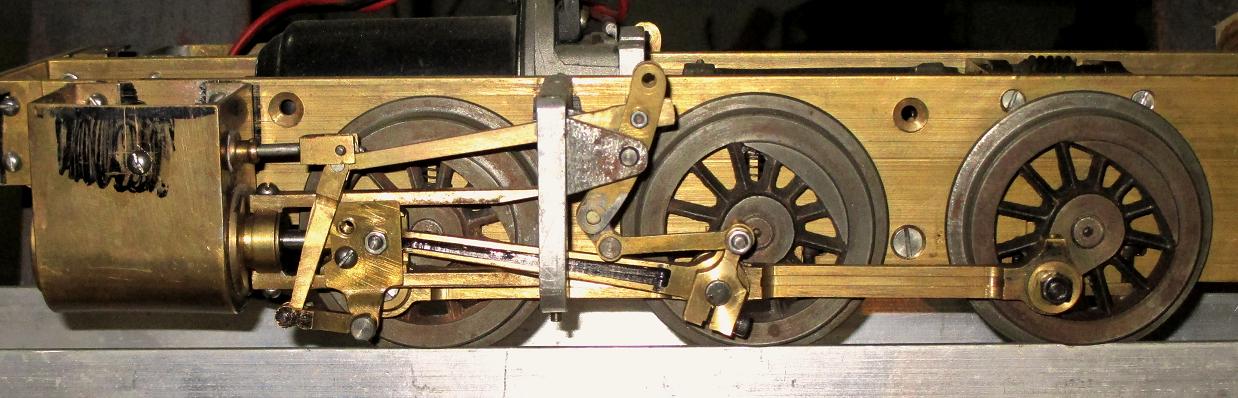
Walschaerts valve gear of the Indian Glory locomotive

Fairy Queen, being a scaled down replica of the full-sized engine, employs Stephenson's link motion to actuate the valves. How did Iqbal design Stephenson's motion for his engine? "While at the National Rail Museum of Delhi, I closely studied the working mechanism of the Fairy Queen, and even took photographs. My model is based on these photos and what I learned while at the museum," he tells us. Indian Glory, on the other hand, works on the more familiar Walschaerts valve gear. Both machines use plain D-slide valves with external admission for steam distribution, and are capable of running in both forward and reverse gear.


Iqbal's locomotives have given entirely satisfactory performance until now, and day-long demonstrations have been held at the National Rail Musuem in Delhi, as well as various other venues. Has he ever had occasion to replace a working part of the locomotive? "Wear is minimum here," explains Iqbal. "The cylinder, piston rings, and connecting rod bushes are made of gun metal which is wear resistant. If a connecting rod bush wears away, I only need to replace it with a new one, but so far there has been no need for this. All external working parts are kept well lubricated manually with an oil can before a run."

Perhaps the only thing lacking is the facility for boiler inspection and washout. "From time to time, I clean out the smoke tubes to rid them of the accumulated soot, but there is no way you can open out the boiler for removing scale. All we can do is fill up the boiler and empty its contents through a blow down valve," he says.

And so Iqbal’s collection stands, a poignant reminder of the industrial revolution and of those adventurous times when men were tinkering with mechanical innovations, and physics had begun to unravel the secrets that underlay their successful operation. His hand-crafted miniature models constitute a unique collection that is bound to be of tremendous interest both to steam engine enthusiasts and students of industrial history alike.

Does he have plans to work on any new models? "At the moment, I am preparing a full-size model of the 1886 Benz Motor Wagen," says Iqbal. As for future plans, there are none in sight as yet. "When something interesting presents itself, I will begin to work on it," he says.

Perhaps something interesting will turn up. Having made a great variety of engines both large and small, it is hoped that he will turn his attention in due course to other innovations that made their appearance during the early years of the industrial age. Who knows what lies in store ahead—perhaps one day, Iqbal will surprise us with a model of an early printing press, a spinning jenny, or maybe even Lumiere's kinematograph !

The master craftsman is at work currently on an elecrically
driven locomotive model.

....................................
Ravindra Bhalerao